Summary
SANYO Shinkansen
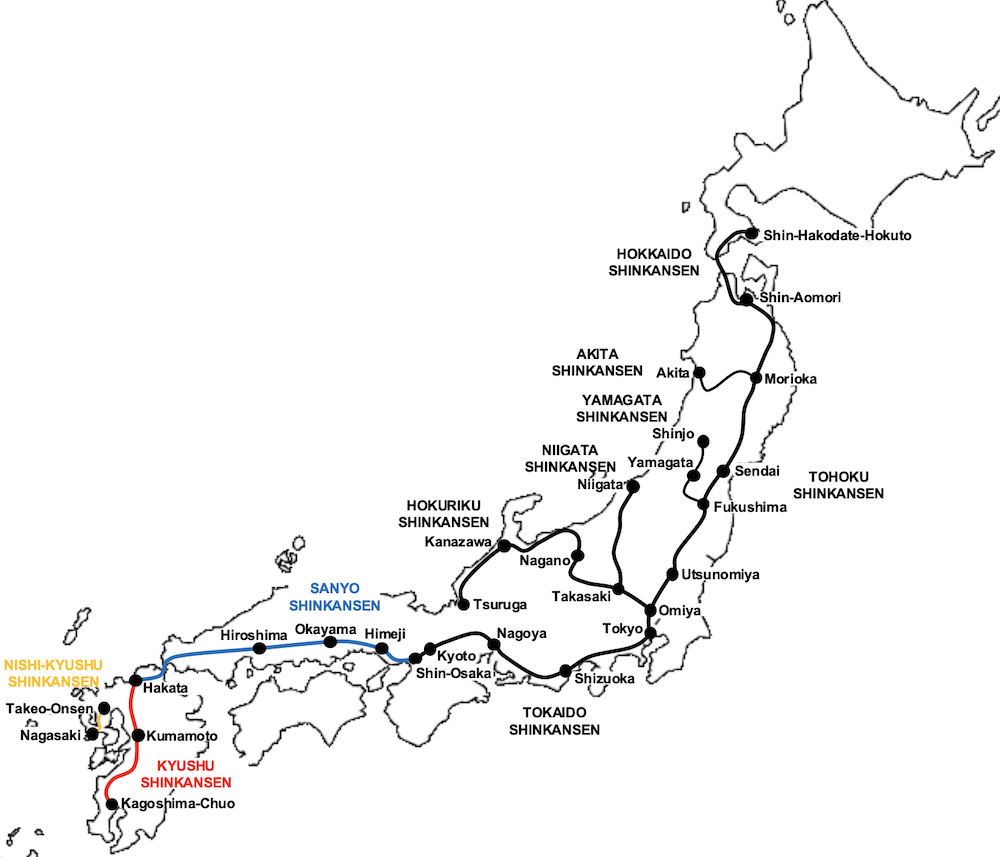
The Sanyo Shinkansen runs from Osaka to Hakata in Fukuoka, connecting Kobe, Okayama, Hiroshima, and Kitakyushu. It links seamlessly with both the Tokaido Shinkansen to the east and the Kyushu Shinkansen to the south.
There are four main services: Nozomi, Mizuho, Sakura, and Kodama. The fastest are Nozomi and Mizuho, followed by Sakura, while Kodama stops at every station. Nozomi continues onto the Tokaido Shinkansen toward Tokyo, operated with 16-car N700 series trains. Mizuho and Sakura run through onto the Kyushu Shinkansen, generally using 8-car N700 series trains.
Highlights along the route include the majestic Himeji Castle, Korakuen Garden in Okayama, the moving Peace Memorial Park in Hiroshima, and the scenic Seto Inland Sea. Seasonal delicacies such as Hiroshima oysters and Setouchi citrus fruits enrich the journey.
KYUSHU Shinkansen
The Kyushu Shinkansen stretches from Hakata in Fukuoka to Kagoshima-Chuo, offering a fast and scenic trip through Kyushu’s mountains, hot springs, and coastline.
There are three main services: Mizuho, Sakura, and Tsubame. Mizuho is the fastest, linking Hakata and Kagoshima-Chuo in about 1 hour and 20 minutes. Sakura makes more stops but still provides a swift journey across the island. Tsubame mainly serves local travel within Kyushu, stopping at all stations.
All services are operated by 8-car N700 series trains or 6-car 800 series, offering comfortable seating and modern facilities.
Highlights include the hot spring resorts of Kumamoto, Ibusuki, and Kirishima, the imposing Kumamoto Castle, and the iconic Sakurajima volcano near Kagoshima. Visitors can also enjoy Kyushu’s rich food culture, from Hakata ramen to Kagoshima black pork and shochu.
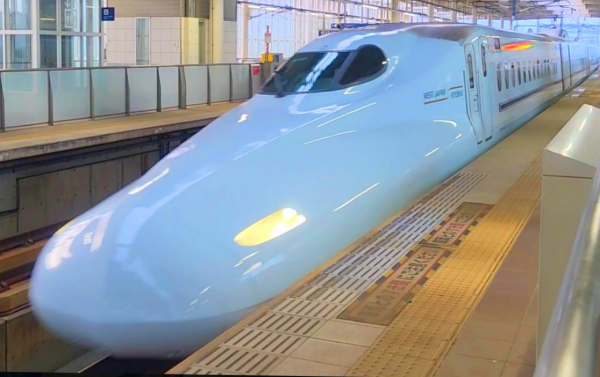
N700 series train set
Route map
Train types
NOZOMI (TOKAIDO, SANYO SHINKANSEN)
The fastest service on the Sanyo and Tokaido Shinkansen, Nozomi connects Tokyo and Hakata in about 5 hours, and Osaka and Hakata in around 2 hours and 30 minutes. It makes limited stops at major stations such as Shin-Osaka, Okayama, and Hiroshima. Operated with 16-car N700 series trains, Nozomi offers the quickest and most frequent long-distance option.
MIZUHO (SANYO, KYUSHU SHINKANSEN)
Mizuho is the fastest train on the Sanyo and Kyushu Shinkansen, running directly between Shin-Osaka and Kagoshima-Chuo in about 3 hours and 45 minutes. It stops only at key stations such as Okayama, Hiroshima, Hakata, Kumamoto, and Kagoshima-Chuo. Trains are 8-car N700 series sets, combining speed with comfort.
SAKURA (SANYO, KYUSHU SHINKANSEN)
Sakura services operate between Shin-Osaka and Kagoshima-Chuo, making more stops than Mizuho but still providing a fast connection. Popular with both tourists and business travelers, Sakura serves cities such as Himeji, Hiroshima, Hakata, and Kumamoto. Trains are also 8-car N700 series.
HIKARI (TOKAIDO, SANYO SHINKANSEN)
Hikari is the second-fastest service on the Tokaido and Sanyo Shinkansen. It stops more often than Nozomi, calling at cities such as Shizuoka, Okayama, and sometimes Himeji. Operated with 16-car N700 series trains.

KODAMA (TOKAIDO, SANYO SHINKANSEN)
Kodama stops at every station along the Tokaido and Sanyo Shinkansen lines. It is ideal for visiting smaller towns and regional destinations, though it takes longer for end-to-end journeys.

TSUBAME (KYUSHU SHINKANSEN)
Tsubame is a local service on the Kyushu Shinkansen, mainly operating between Hakata and Kumamoto or Kagoshima-Chuo. It stops at nearly all stations, making it useful for regional travel within Kyushu.

Seat types
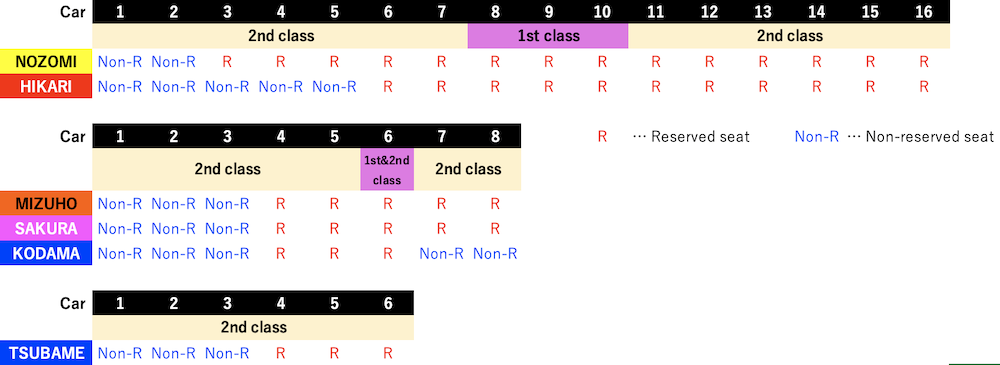
- In the Green Car, all seats are reserved.
- On KODAMA and HIKARI trains, the non-reserved seat cars may differ depending on the train.
1st class (Green car)
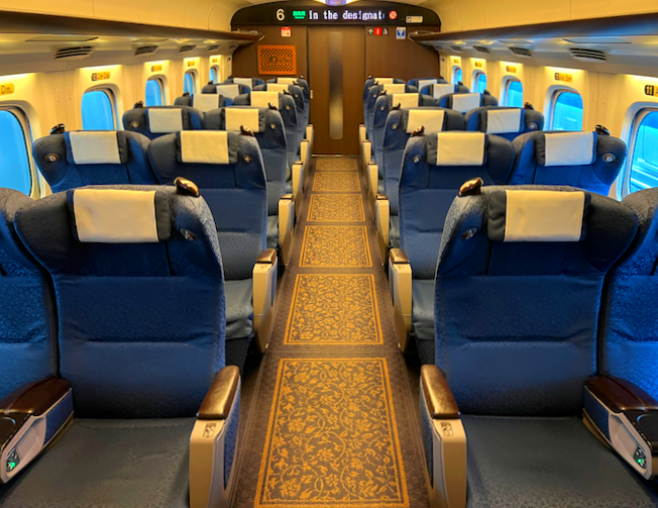
1st class is called “Green Cars.” All seats are reserved. They feature a 2+2 seating layout with a seat pitch of 1,160 mm, offering comfort even on long journeys.
2nd class / Reserved, 8-car (Ordinary car)
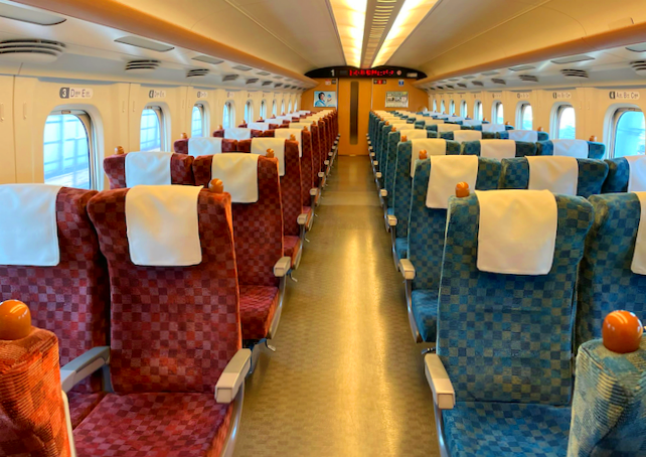
Operated with N700 series 8-car trains. Cars 4 to 8 are 2nd class, with a 2+2 seating layout.

2nd class / Non-reserved (Ordinary car)
In the N700 series, 2nd class in 16-car and 2nd class non-reserved cars in 8-car have a 2+3 seating layout.
Stops
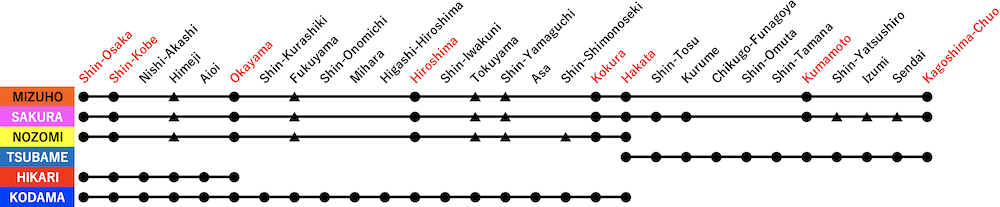
- The stops of the trains vary depending on the train.
- ▲ indicates stations where only some trains stop.
Travel Times and Fares for Major Sections
| Route | Type | Time | 1st class |
2nd class (R) |
2nd class (Non-R) |
|---|---|---|---|---|---|
| Tokyo - Hakata | NOZOMI | 5h | ¥31070 | ¥23810 | ¥22200 |
| Tokyo - Hiroshima | NOZOMI | 3h50m | ¥27020 | ¥19760 | ¥18380 |
| Tokyo - Okayama | NOZOMI | 3h10m | ¥23840 | ¥17770 | ¥16600 |
| Tokyo - Himeji | NOZOMI | 3h | ¥22640 | ¥16570 | ¥15400 |
| Shin-Osaka - Kagoshima-Chuo | MIZUHO | 3h50m | ¥34620 | ¥24360 | ¥23090 |
| Shin-Osaka - Kumamoto | MIZUHO | 3h10m | ¥29100 | ¥20230 | ¥18960 |
| Shin-Osaka - Hakata | NOZOMI MIZUHO |
2h30m | ¥22090 | ¥16020 | ¥14750 |
| Shin-Osaka - Hiroshima | NOZOMI MIZUHO |
1h30m | ¥14610 | ¥10950 | ¥9890 |
| Shin-Osaka - Okayama | NOZOMI MIZUHO |
45m | ¥8730 | ¥6460 | ¥5610 |
| Shin-Osaka - Himeji | NOZOMI MIZUHO |
30m | ¥4840 | ¥4070 | ¥3220 |
| Hakata - Kagoshima-Chuo | MIZUHO | 1h20m | ¥15610 | ¥11950 | ¥11420 |
| Hakata - Kumamoto | MIZUHO | 30m | ¥8110 | ¥5840 | ¥5310 |
- "(R)" means fare with seat reservation.
- "(Non-R)" means fare with Non-seat reservation.
- Children aged 6 to under 12 pay half of the adult fare for 2nd class seats. Children under 6 travel free, but a child fare is required if a seat is reserved.
- The following fares are standard fares. During busy seasons, an additional ¥400 applies. During off-peak seasons, ¥200 is discounted.
Onboard facilities
Restrooms
Located approximately once every two cars.

Oversized baggage compartment
Available in cars 6, 9, 13, and 15. The space behind the last-row seats is reserved for passengers seated in those last-row seats.
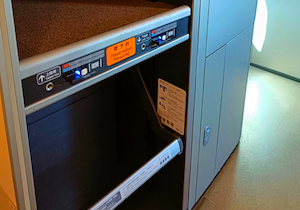
Oversized baggage area
Baggage with total dimensions (A+B+C) of between 160 and 250 cm requires a reservation. The areas is behind the back row. Passengers traveling with oversized baggage without a reservation will be charged a baggage fee (¥1000).

Power outlets
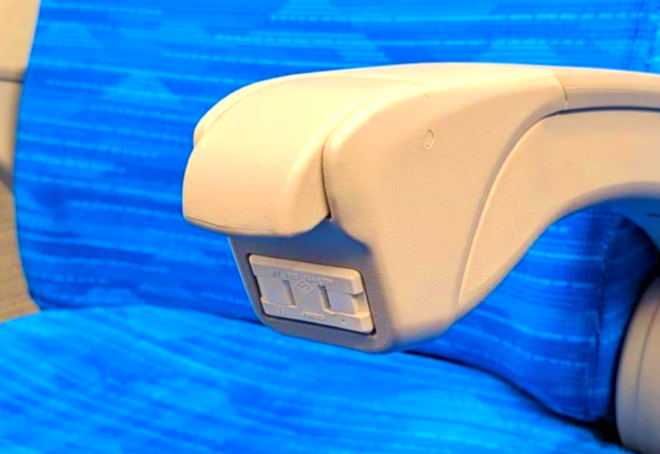
On the N700S, every seat is equipped with a power outlet. On the N700A, outlets are available at every seat in 1st class (Green Cars), and at window seats in 2nd class.
Wi-Fi
All trains offer free Wi-Fi service.

Timetable
The timetable is frequently updated. Please check the latest version on the JR West website or the JR Kyushu website .
Major sightseeing spots
Osaka
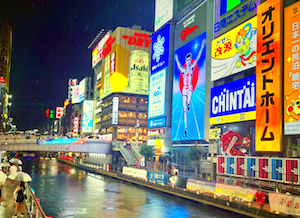
Osaka is known as Japan’s “kitchen,” famous for dishes like takoyaki and okonomiyaki. Visitors can experience the lively atmosphere of Dotonbori as well as historic landmarks such as Osaka Castle.
KOBE
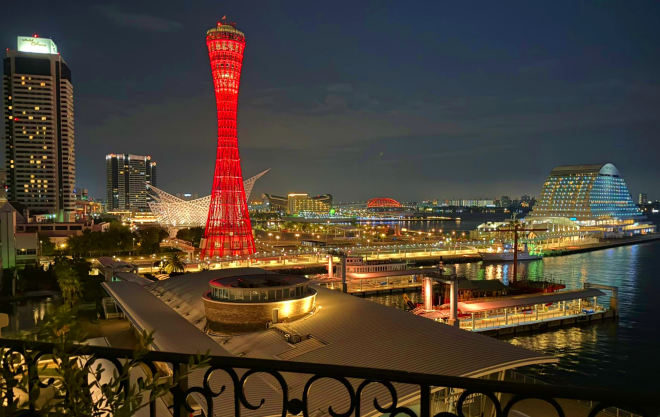
Kobe is a cosmopolitan port city known for its scenic waterfront, stylish shopping streets, and world-famous Kobe beef. The city also offers views of Mount Rokko and the historic Kitano district.
HIMEJI
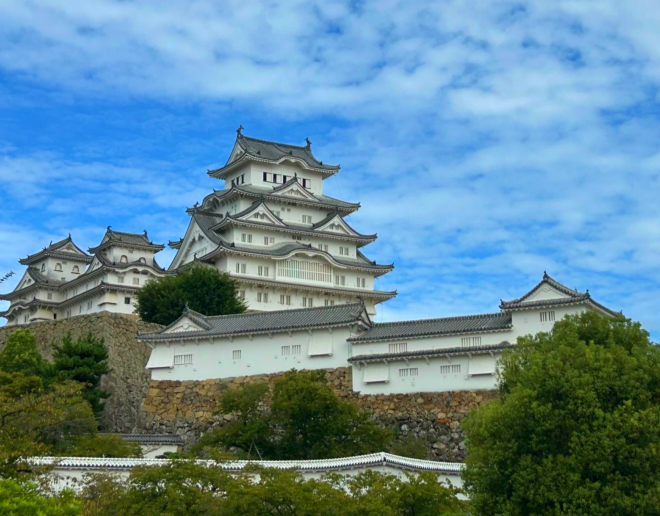
Himeji is home to the magnificent Himeji Castle, a UNESCO World Heritage site. The city combines history with seasonal beauty, as the castle grounds are especially stunning during cherry blossom season.
OKAYAMA
Okayama is best known for Korakuen Garden, one of Japan’s three great gardens, and Okayama Castle. It also serves as a gateway to Kurashiki’s preserved merchant quarter and the Seto Inland Sea.

HIROSHIMA
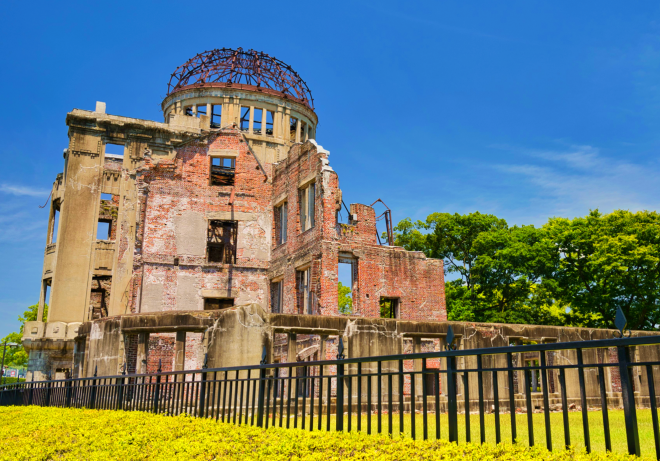
Hiroshima is remembered for the Peace Memorial Park and Atomic Bomb Dome, symbols of peace. Visitors can also enjoy Hiroshima-style okonomiyaki and take a ferry to the sacred island of Miyajima.
HAKATA
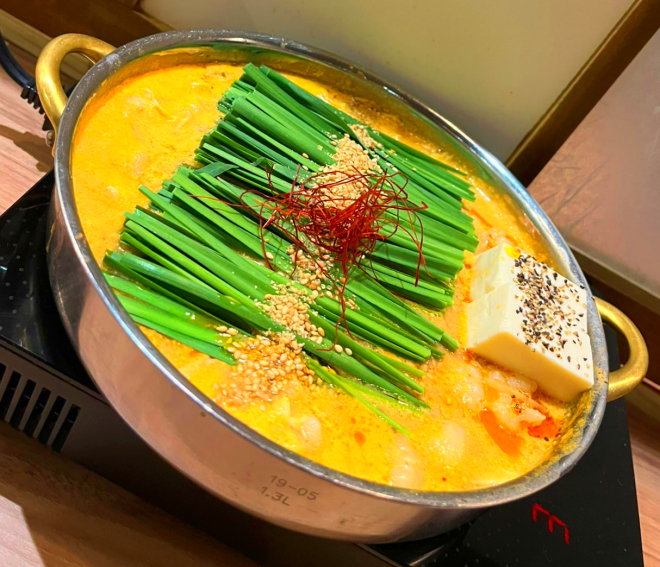
Hakata, part of Fukuoka City, is famous for its lively food stalls (yatai) and Hakata ramen. The city is also a cultural hub with festivals like Hakata Gion Yamakasa and easy access to Kyushu.
KUMAMOTO
Kumamoto is known for its impressive Kumamoto Castle and beautiful Japanese gardens such as Suizenji Jojuen. The region also offers access to Mount Aso and relaxing hot spring towns.

KAGOSHIMA
Kagoshima is set against the dramatic backdrop of Sakurajima, an active volcano. Visitors can also enjoy hot spring resorts like Ibusuki and sample local specialties such as sweet potatoes and black pork.
Important Notes
- Holidays in May, August, and December are extremely crowded. During these periods, all seats on the Nozomi are reserved.
- The morning and evening hours are also very crowded.
- The MIZUHO tends to be extremely crowded, so early reservations are highly recommended.